Losing a tooth leaves a gap that affects more than how your smile looks. It changes how you bite, how your jawbone behaves over time, and in some cases, the long-term health of the teeth on either side. Two of the most common ways to address a missing tooth are dental implants and dental bridges, and both are legitimate options depending on the situation.
The challenge is that many patients are told one option without fully understanding when the other might serve them better. This post lays out ten signs that an implant may be the more appropriate choice for your specific situation.
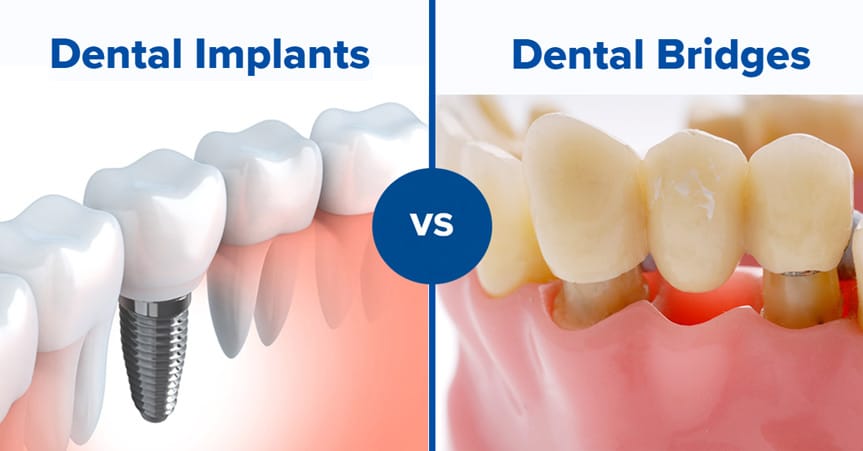
Implants vs. bridges: a quick comparison
A dental bridge fills a gap by anchoring a false tooth to the natural teeth on either side. Those neighbouring teeth are permanently altered to support the bridge. A dental implant replaces the tooth root with a titanium post placed in the jawbone, then a crown is attached on top. The implant stands on its own and does not rely on adjacent teeth for support.
Both can restore function and appearance. The right choice depends on your oral health, your bone density, your budget, and the condition of your surrounding teeth.
10 signs a dental implant may be the right choice
1. The teeth on either side of the gap are healthy
A bridge requires the two neighbouring teeth to be filed down so the bridge can be cemented over them. If those teeth are healthy and have no existing restorations, altering them to support a bridge means permanently removing enamel from teeth that didn’t need treatment. An implant leaves adjacent teeth completely untouched.
2. You have adequate jawbone density
Implants require sufficient bone in the jaw to anchor the titanium post. If bone density is adequate at the time of assessment, you’re a stronger candidate for an implant. If there has been significant bone loss, a bone graft may be needed first, which adds to the timeline but does not necessarily rule out an implant.
3. You want to preserve long-term jawbone health
When a tooth root is lost, the bone beneath it begins to resorb over time because there is no longer any stimulation in that area. A bridge replaces the visible tooth but does nothing for the bone below the gap. An implant post sits in the bone and provides the stimulation needed to slow that resorption process.
4. You are missing more than one non-adjacent tooth
Bridges work well for a single gap or a small span. When multiple teeth are missing in different areas of the mouth, implants are generally a more practical solution. Each implant is self-supporting, so you can replace several teeth independently without requiring every gap to be adjacent.
5. You are concerned about the lifespan of your restoration
Bridges typically last 10 to 15 years before they may need to be replaced, depending on wear and oral hygiene. Implants, when placed in a healthy jaw and cared for properly, can last considerably longer. For younger patients especially, the long-term outlook of the restoration is worth factoring into the decision.
6. The neighbouring teeth already have crowns or significant restorations
If the teeth adjacent to your gap already have crowns, a bridge may make sense since those teeth have already been altered. But if they are largely intact and cavity-free, an implant avoids the need to crown otherwise healthy teeth just to anchor a bridge.
7. You prefer cleaning that resembles a natural tooth
A bridge connects the replacement tooth to its anchors, which means you cannot floss between those teeth in the usual way. A floss threader or water flosser is needed to clean under the bridge. An implant is a standalone structure and can be brushed and flossed the same way as a natural tooth. For patients who find bridge hygiene difficult to maintain, this is a practical difference.
8. You are in good general health with no uncontrolled systemic conditions
Implant placement is a surgical procedure. Patients with well-managed health are generally good candidates. Certain conditions, including uncontrolled diabetes or active gum disease, can affect how the implant site heals. Your dentist will review your health history before recommending implant treatment to determine whether it’s appropriate and when.
9. You are a non-smoker or willing to stop smoking for treatment
Smoking affects healing and increases the risk of implant complications. It is one of the more significant factors dentists assess when reviewing implant candidacy. Patients who do not smoke or who are prepared to stop around the time of placement and healing are stronger candidates than those who continue smoking throughout the process.
10. You want to avoid altering the structure of your other teeth
Some patients feel strongly about keeping their remaining natural teeth as intact as possible. That’s a reasonable position. An implant is the only tooth replacement option that does not involve modifying healthy neighbouring teeth. If preserving tooth structure is a priority for you, that preference is worth raising directly with your dentist.
When a bridge may be the more practical option
A bridge is often recommended when bone density is insufficient for an implant without grafting, when the adjacent teeth already need crowns, when the patient’s health or healing capacity makes surgery less advisable, or when treatment timeline and cost are primary considerations. Neither option is universally superior. The right choice depends on what’s happening in your mouth specifically.
What to ask at your consultation
If you’re weighing implants against a bridge, a few questions are worth raising directly with your dentist:
- Do my adjacent teeth need to be altered for a bridge, and are they currently healthy?
- What does my current bone density look like at the site?
- How does my medical history affect my candidacy for an implant?
- What is the realistic lifespan of each option given my oral health?
- What does the full treatment timeline look like for each?
A dentist who takes the time to walk through both options in the context of your specific clinical picture is giving you information you can actually use. At True Roots Dental in Stony Plain, Dr. Rahim Ali and Dr. James Quon assess implant and bridge candidacy as part of a full treatment planning conversation, not a one-size recommendation.
True Roots Dental | Stony Plain, AB
If you’re missing a tooth and unsure whether an implant or a bridge is the right path, the clearest next step is a proper assessment. Book a consultation with Dr. Ali or Dr. Quon at True Roots Dental to review your options.
Call (780) 963-4885 or visit the clinic at 4305 S Park Dr #400, Stony Plain, AB. True Roots Dental accepts the Canadian Dental Care Plan (CDCP) and offers direct billing to most insurance providers. New patients from Stony Plain, Spruce Grove, and Parkland County are welcome.